


ProMach is your partner from start to finish. Our product brands are grouped into distinct business lines that make the most sense to our customers, covering every function of the production line: Filling, Bottling & Capping, Decorative Labeling, Flexibles & Trays, Pharma, Handling & Sterilizing, Labeling & Coding, Robotics & End of Line, and Systems & Integration.
learn moreFinding the best Thermal Sticker Labels in China starts with matching the label to its real working conditions. A parcel label facing warehouse humidity needs different adhesive performance from a shelf label used indoors. Printer compatibility matters, too. Check the roll core, label width, coating, and barcode clarity before comparing prices. Small mismatches can cause jams, faint prints, or labels that lift at the corners.
China’s supplier base is broad, with manufacturers and converters across regions such as Guangdong, Zhejiang, and Jiangsu. The right choice depends less on a company’s location than on its production controls, material options, and ability to provide consistent samples. Ask for a trial roll made to your actual size and test it on your own printer. Review print darkness, feeding, adhesion, and readability after handling. One detail is easy to miss: a clean sample does not guarantee every production batch will perform the same.
In this guide, sourcing specialist Lin Wei offers a practical rule: “Choose the label that performs reliably on your printer, not merely the one with the lowest quote.” Use that principle to assess suppliers, compare direct manufacturers with trading companies, and clarify specifications before ordering. Ask how the supplier checks coating uniformity and roll winding. Confirm packaging and lead-time expectations in writing. A low price can still be useful, but only when the sample and stated specifications match your needs. I would not treat a polished catalog as proof; real testing may reveal issues the product photos cannot show.
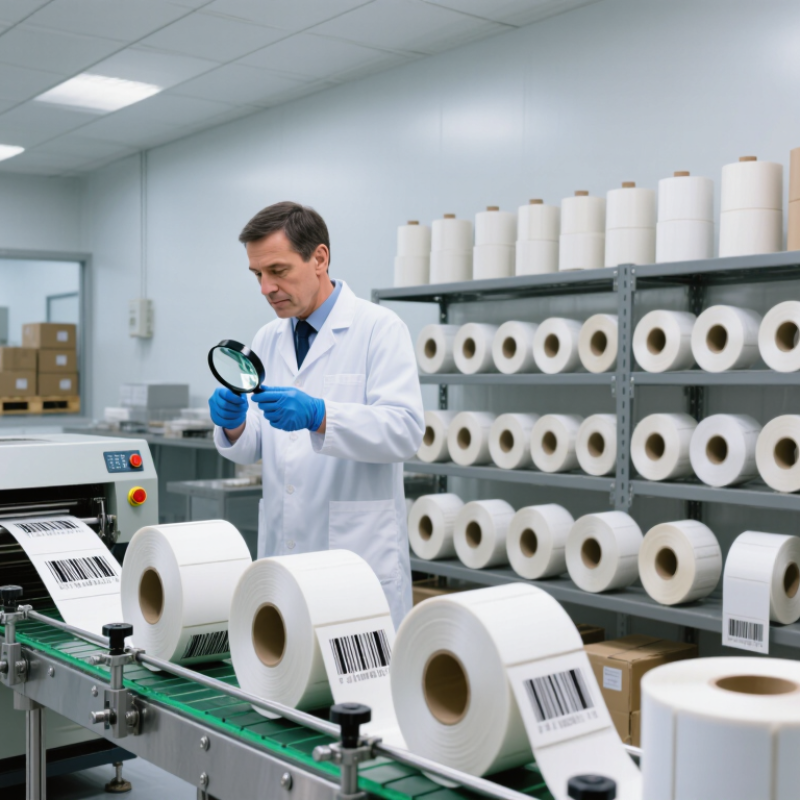
Where to Find the Best Thermal Sticker Labels in China?
What Thermal Sticker Labels Are and How They Are Used
Thermal sticker labels are printable labels with a heat-sensitive surface. A thermal printer creates text or barcodes by applying heat. Direct thermal labels need no ink ribbon, making them useful for shipping slips, short-term tracking, and queue tickets. Thermal-transfer labels use a ribbon, which can help produce prints that last longer under handling or storage. The two types are easy to confuse. They are not interchangeable in every printer.
You’ll find these labels on parcels, shelves, inventory bins, and prepared-food containers. A clear barcode matters, but so does the label’s adhesive. A label that sticks well to a clean carton may lift from a cold, dusty, or curved surface. Consider exposure to sunlight, moisture, friction, and heat before choosing a material. Small details matter. Testing a sample on the actual surface can reveal problems that a product description won’t. The right choice depends on the job, not just the printer.
Tips: Check your printer’s label and core specifications, then print a small test batch. Scan the barcodes and rub the print gently. If edges peel or text fades, reconsider the adhesive or label type. It may take a second try; that’s normal.
When sourcing thermal sticker labels in China, test the exact face stock, adhesive, and printer combination you will use. Direct thermal paper suits short-life shipping labels, but heat and sunlight can fade printed text. Thermal-transfer labels usually last longer, though they require a compatible ribbon. Ask for samples in your actual label size. Check edge lift on cardboard, glass, or plastic—not just on a clean desk. Ask for evidence.
MarketsandMarkets estimated the global labels market at USD 48.6 billion in 2023 and forecast USD 67.0 billion by 2028 in its Labels Market report. That figure covers many label types, not thermal labels alone, but it signals a competitive, growing market. Compare suppliers on measurable quality: roll-width tolerance, print darkness, adhesive consistency, and batch-to-batch variation. Request recent inspection records and a sample report tied to the production lot. A polished sample roll can still hide uneven coating.
Check production capacity, lead times, packaging, and how complaints are handled. Ask whether the supplier can trace a lot from coating through packing, and request a small pilot order before scaling up. Confirm core size and winding direction with your printer operator; these details are easy to miss. Do not rely on a broad “compatible with all printers” claim. Get the specifications in writing, then test them under your storage and transport conditions. I would still retest after a material change—supplier assurances are useful, but not enough.
China’s thermal-label supply base is concentrated around coastal manufacturing and logistics corridors, rather than one single market. Guangdong—including Guangzhou, Dongguan, and Shenzhen—offers converters, adhesive-material suppliers, and export logistics within reach. Zhejiang’s Hangzhou, Ningbo, and Wenzhou, along with Jiangsu’s Suzhou and Wuxi, are other practical sourcing zones. Shanghai is useful for trading, freight access, and supplier meetings, though many production sites sit outside the city. That distinction matters.
For raw-material context, the China Paper Association’s 2023 annual report recorded 127.05 million tonnes of paper and paperboard production and 131.65 million tonnes of consumption in China. These figures describe the wider paper sector, not thermal-label output, so they should not be mistaken for label-capacity data. When visiting manufacturers, check coating uniformity, roll-edge finish, core size, adhesive performance, and whether sample rolls suit your printer and storage conditions. Ask for recent test records. A directory alone can mislead. Factory clusters save travel time, but quality still varies by coating line and quality-control practices.
When comparing Chinese thermal sticker label suppliers, start with the label’s job, not the quotation. Specify direct thermal or thermal transfer, roll width, core size, winding direction, and the surface it must stick to. A 50 mm label for clean cartons may behave very differently on a cold, dusty bottle. Small details matter. Ask for the face stock, adhesive, and liner specifications in writing, then compare like with like.
Request sample rolls from each shortlisted supplier and print them on your own printer. Check darkness, edge sharpness, feed consistency, and whether the image fades after rubbing or brief heat exposure. Test adhesion on the actual package after several hours, not just on a clean desk. Ask how coating and adhesive batches are checked, and whether inspection records are available. A neat sample is useful, but it does not prove every production run will match.
Compare lead time, minimum order quantity, packaging, and response speed alongside price. Get written tolerances for roll count, label dimensions, and splice limits; these details can affect automated packing. If a supplier answers technical questions vaguely, pause and ask again. The lowest quote may still be right, but only after comparable testing. No checklist catches everything. Keep trial results, note what failed, and revise the specification before placing a larger order.
| Comparison Factor | What to Compare | Evidence to Request from Each Supplier |
|---|---|---|
| Label technology | Direct thermal labels use heat-sensitive coating and do not require a ribbon. Thermal transfer labels use a ribbon and are available with paper or film face materials. | Product specification identifying the printing method, face material, coating, and compatible ribbon type, if applicable. |
| Face material | Common options include direct thermal paper, thermal-transfer paper, and film materials such as PP or PET. Select according to print durability, moisture exposure, and application conditions. | Material data sheet and samples printed on the intended printer. Confirm whether the material is paper or film and whether a topcoat is included. |
| Adhesive | Compare permanent, removable, and application-specific adhesives. Performance can change with the surface, temperature, humidity, and application method. | Adhesive technical data, recommended application conditions, and test samples on the actual packaging or surface. |
| Print durability | Direct thermal print can be affected by heat, light, abrasion, oils, and some chemicals. Thermal-transfer durability depends on the label face stock and ribbon combination. | Test results or samples exposed to the conditions expected in storage, transit, and use. For thermal transfer, request a recommended ribbon match. |
| Barcode quality | Check that barcodes remain readable after printing and handling. ISO/IEC 15416 specifies a method for measuring the print quality of linear barcodes. | Barcode samples printed at the intended size and speed, plus a verification report where barcode grading is required. |
| Adhesion testing | Peel adhesion results are meaningful only when the test method, substrate, dwell time, and conditions are specified. ASTM D3330/D3330M is one recognized test method for pressure-sensitive tape peel adhesion. | Test method and conditions, reported results, and samples tested on the intended substrate. Do not compare results from different methods as if they were equivalent. |
| Roll and core format | Confirm label width and height, gap or black-mark format, winding direction, labels per roll, roll diameter, and core diameter. Core sizes such as 25.4 mm, 38.1 mm, and 76.2 mm are commonly encountered, but are not universal. | A roll drawing or specification sheet and a production sample that fits the intended printer and applicator. |
| Printer compatibility | Compatibility depends on printer type, sensor requirements, label dimensions, roll direction, and ribbon configuration for thermal-transfer printing. | Written confirmation against the printer model and label specification, followed by a test roll for a print and feed trial. |
| Dimensions and tolerances | Compare label size, material thickness, roll diameter, core size, and agreed tolerances. There is no single tolerance that applies to every label order. | Approved product drawing or specification listing nominal dimensions, tolerances, and the inspection method. |
| Order quantity and lead time | Minimum order quantity, sample availability, production lead time, and repeat-order timing vary by material, size, printing, and finishing requirements. | A written quotation stating the quantity basis, sample charges if any, production schedule, packaging details, and shipment terms. |
| Quality controls | Compare incoming-material checks, in-process inspection, finished-roll inspection, and traceability. An ISO 9001 certificate indicates a quality-management system; it does not by itself certify a particular label’s performance. | Current certificate details where claimed, inspection records, batch identification, and the supplier’s process for handling non-conforming goods. |
| Regulatory documentation | Requirements depend on the label’s end use and destination market. Request only the declarations and test reports applicable to the product and application. | Relevant material declarations or test reports, with product scope and issue date clearly identified. |
| Packaging and transport | Compare protection against dust, moisture, crushing, and roll deformation, especially for long-distance shipping and storage. | Packaging specification, carton quantity and dimensions, pallet details if required, and photos or samples of export packaging. |
| Supplier capabilities, prices, minimum order quantities, and lead times vary by specification and order. Treat these as comparison criteria and confirm all product details, test conditions, and commercial terms in writing before purchase. | ||
Where to Find the Best Thermal Sticker Labels in China?
When comparing suppliers, ask for the exact label construction: face stock, thermal coating, adhesive, and release liner. These details affect print clarity, sticking power, and performance in cold or humid conditions. Request technical data for the intended printer and use. A label that looks sharp on a desk may fade after days in a warm warehouse.
Check certificates carefully. Confirm the issuing organization, validity dates, product or factory scope, and whether the documents apply to the specific material offered. Requirements vary by market and application, so a generic certificate may not answer your question. Ask for test reports covering relevant properties, such as image durability or adhesive performance. Verify details with the issuer when possible. Small paperwork gaps matter.
Order samples before committing to a large run. Test them on your own printer, using the actual speed and darkness settings. Scan a few printed barcodes, rub the surface, and apply labels to the packaging you use. Inspect roll edges, winding, core size, and label spacing. Keep notes and compare samples side by side. One sample cannot prove every batch will match; it is easy to trust a clean first roll too much. Ask how the supplier controls production consistency and handles out-of-spec lots.
How to Verify Product Quality, Certifications, and Sample Orders
How to use this chart: The bars show recommended buyer checks, not supplier ratings or market statistics.
For product quality, check thermal image clarity, barcode readability, adhesive performance, roll dimensions, and print durability. For certifications, verify certificate scope, issuer, and validity, and request applicable material-compliance documents. For samples, confirm the written specification, test labels in your own printer and on the intended surface, check barcode scans, and assess print and adhesive performance under expected conditions.