
ProMach is your partner from start to finish. Our product brands are grouped into distinct business lines that make the most sense to our customers, covering every function of the production line: Filling, Bottling & Capping, Decorative Labeling, Flexibles & Trays, Pharma, Handling & Sterilizing, Labeling & Coding, Robotics & End of Line, and Systems & Integration.
learn moreGlobal buyers comparing China’s HDPE bottle manufacturers need more than a low unit price. They need stable resin quality, accurate neck finishes, dependable lead times, and clear communication when specifications change. Small details matter. A cap that fits poorly can leak in transit; uneven wall thickness can affect handling and filling. These checks are practical, not cosmetic.
Packaging scholar Susan Selke’s work encourages buyers to consider packaging across its life cycle, rather than judging a material in isolation. That perspective matters when selecting an hdpe bottle. Buyers should assess product compatibility, bottle weight, color consistency, closure fit, and the supplier’s quality-control process. Ask for samples. Compare the actual bottles under filling and transport conditions, not just in a polished catalog image. A good-looking sample is not proof of consistent production.
This guide examines Chinese manufacturers through those purchasing priorities: production capability, customization, quality assurance, export experience, and communication. It also considers how suppliers handle drawings, inspection records, and repeat orders. The strongest partner is not always the largest factory. Sometimes a smaller supplier responds faster, but its capacity may be less flexible during peak demand. That trade-off deserves an honest look. No supplier is perfect, and a confident sales promise should never replace a clear specification and a checked sample.
HDPE bottle resin commonly falls within a density range of 0.941–0.965 g/cm³. ASTM D1505 and ISO 1183-1 describe established methods for measuring plastic density. A supplier’s test result is most useful when it also identifies the method, sample conditioning, and resin grade.
One detail is easy to miss: a single number does not describe the whole bottle.
Higher density often corresponds to greater crystallinity and stiffness, but wall thickness, molding conditions, and resin structure also affect handling and performance. Ask manufacturers for a lot-specific certificate of analysis, then compare results against the agreed specification.
Check the paperwork. OECD’s Global Plastics Outlook (2022) estimated that 353 million tonnes of plastic waste were generated worldwide in 2019. That figure makes traceable material information relevant, though density alone cannot verify recycled content or recyclability.
A practical review should pair the density result with bottle samples, closure fit, and filled-package trials. Even then, results can vary between production runs; that uncertainty deserves attention, not a sales claim.
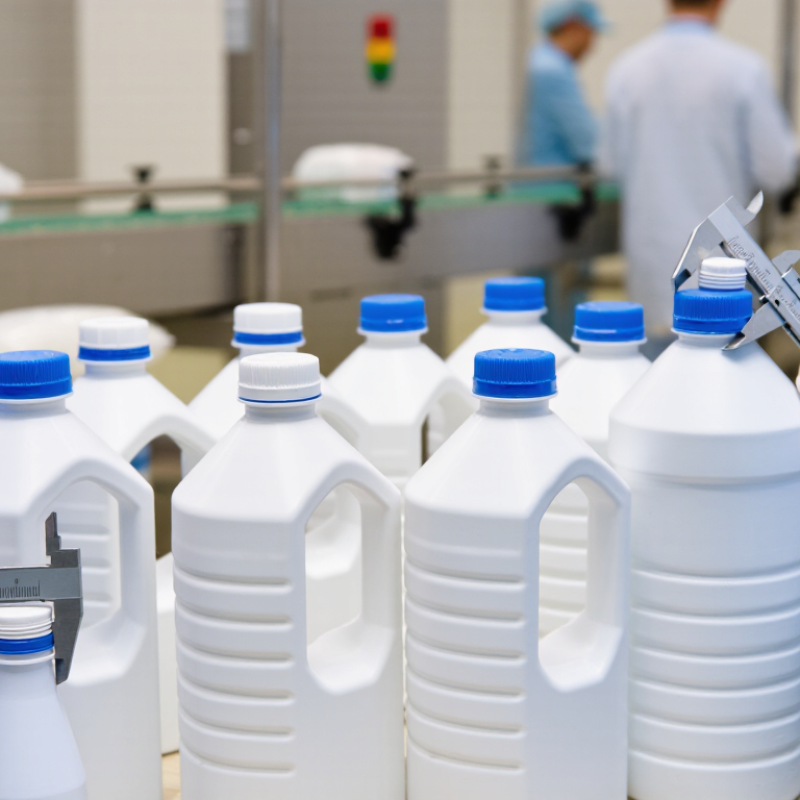
China’s HDPE bottle production often uses extrusion blow molding. A heated tube of plastic, called a parison, drops between open mold halves. The mold closes, and compressed air pushes the plastic against its inner walls. After cooling, the bottle is released and excess material is trimmed. Cooling takes patience. Uneven temperatures can create thin spots, rough seams, or distorted necks. Buyers should ask how suppliers control these variables across production runs, not just inspect a sample.
Tips: Request bottle drawings, resin specifications, and recent inspection records. Check wall thickness at several points, especially near the base and shoulder. Ask how leak tests and cap-fit checks are recorded.
Reliable quality checks combine visual inspection with measurable tests. Operators may check weight, dimensions, neck finish, and visible contamination. Leak testing can reveal weak seams; drop testing can show how a filled bottle handles impact. Sampling plans matter, but they do not catch every defect. A useful supplier discussion covers test frequency, rejected-product handling, and corrective actions. One detail is easy to overlook: a bottle may pass inspection alone yet fit poorly with the buyer’s chosen closure. Requesting a closure-fit trial before a large order can prevent avoidable rework.
When comparing HDPE bottle manufacturers in China, treat minimum order quantity as a production detail, not just a price condition. MOQ may change with bottle size, resin color, cap choice, and custom tooling. A standard bottle may require fewer units than a new mold. Small orders matter. Ask for written pricing at several quantities, and confirm whether samples, printing, and packaging are included.
Lead times should be divided into clear stages: sample approval, tooling if needed, production, inspection, and dispatch. Request estimated dates for each stage, not one broad delivery promise. For example, a sample may be ready quickly while a custom mold adds weeks. Plans change. Ask what could delay the schedule and how changes will be reported. A spreadsheet can look reassuring, but dates are only useful when their assumptions are visible.
For ISO 9001, request a current certificate and check that its scope covers the relevant manufacturing site and activities. The standard concerns quality management systems; it does not guarantee every bottle will meet your specifications. Ask how the supplier records batch checks, handles defects, and controls changes to materials or processes. Compare these answers with your own inspection needs. A neat certificate is not the whole story. A rushed evaluation can miss practical gaps, so leave time to review samples and written specifications before confirming an order.
Use this checklist to compare suppliers. MOQ and lead times depend on the bottle design, order quantity, tooling, decoration, and production schedule; request written, order-specific figures rather than relying on universal benchmarks.
| Evaluation Area | Information to Request | How to Compare or Verify | Evidence to Keep |
|---|---|---|---|
| Minimum order quantity (MOQ) | MOQ for each bottle size, neck finish, color, and decoration option; state whether the MOQ applies per SKU or per order. | Compare quotations for the same specification. Ask whether a custom color, printing, or label changes the MOQ. | Written quotation showing SKU-level quantities, price breaks, and any setup or tooling charges. |
| Lead time | Separate timelines for samples, first production, repeat orders, decoration, and shipment readiness; confirm when the production clock starts. | Compare like-for-like order quantities and specifications. Confirm whether the quoted time excludes sampling, tooling, inspection, or transport. | Dated production schedule, sample approval milestones, and written delivery terms. |
| ISO 9001 certification | Certificate number, certified legal entity and manufacturing site, certification scope, issuing body, and current validity status. | Check the certificate with the issuing certification body or its verification directory. Confirm that the site and scope cover the relevant manufacturing activities. ISO 9001 certifies a quality management system, not a specific product. | Copy of the certificate and a record of the verification result and date. |
| Bottle specification | Capacity, dimensions, weight, neck finish, closure compatibility, color, and any performance requirements. | Use the same approved drawing and specification sheet when requesting quotes from different suppliers. | Controlled drawing, specification sheet, and approved sample reference. |
| Material and intended use | Confirmation of the HDPE material grade and suitability for the intended contents, filling conditions, and destination-market requirements. | Do not assume a bottle is suitable for food, cosmetics, chemicals, or other regulated uses without documentation specific to the application and market. | Material declaration, applicable test reports, and written confirmation of intended-use suitability. |
| Quality inspection | Inspection checks, sampling approach, defect definitions, leak-test method where applicable, and corrective-action process. | Agree on acceptance criteria before production and clarify how nonconforming goods are handled. | Inspection plan, sample approval record, and batch inspection report. |
| Export and delivery terms | Packing method, carton and pallet details, shipment origin, quoted trade term, and whether freight is included. | Compare quotations using the same delivery term and destination. Account for freight, duties, insurance, and import requirements separately where applicable. | Pro forma invoice, packing details, and agreed shipping terms. |
For food-contact HDPE bottles, resin identity alone does not establish compliance. FDA 21 CFR 177.1520 covers olefin polymers, including polyethylene, and sets requirements tied to polymer composition, extractives, and conditions of use. That is not a blanket approval. Buyers should confirm that the exact resin grade, additives, colorants, and intended food type are covered by supporting documentation. A bottle designed for room-temperature dry goods may need different evidence from one used for oily foods or hot filling.
In the EU, Regulation (EU) No 10/2011 sets an overall migration limit of 10 mg/dm² for plastic food-contact materials, alongside substance-specific limits where applicable. Keep the figures in view. Ask suppliers for a current Declaration of Compliance, migration-test conditions, and traceability records linking the tested sample to production batches. Check that the test reflects the actual bottle wall, cap, contact time, and temperature. A neat certificate can still leave gaps. For buyers, that is the part worth questioning: was the finished packaging assessed for its real use, or only the raw resin? Sources: FDA 21 CFR 177.1520; European Commission Regulation (EU) No 10/2011.
For global buyers comparing China-based HDPE bottle manufacturers, export readiness means more than a quoted freight price. Incoterms 2020 clarify who arranges transport, handles export or import clearance, and bears risk at the agreed delivery point. They do not replace a precise purchase contract. Name the rule and location clearly, such as “FCA, supplier’s loading point,” and confirm who books freight and insurance. Small wording gaps matter.
Transit testing deserves equal attention. ISTA 3A is designed for packaged products moving through parcel delivery systems; test the actual shipping configuration, not just a loose bottle. A filled bottle, capped and packed in a carton, behaves differently from empty bottles nested in a case. Check closure leakage, panel deformation, carton strength, and pallet stability after testing. ISTA 3A helps assess hazards, but it cannot reproduce every route or handling event. That limitation is easy to overlook.
UNCTAD’s Review of Maritime Transport 2024 reported that maritime trade grew 2.4% in 2023, while containerized trade declined 0.3%, illustrating uneven shipping conditions. Buyers should align the test plan with the chosen Incoterm, packaging, and delivery method before production. Keep the test report, packing specification, and shipment documents together. We sometimes assume a passed test settles everything. It does not. Recheck when bottle weight, carton design, or transport mode changes.