
China Top 10 Advertising Flag Hardware Manufacturers?

Advertising flags look simple from a distance. Up close, their performance depends on precise hardware: a flexible pole, secure connectors, a stable base, and fabric that moves without tearing. This guide to China’s top 10 Advertising Flag Hardware manufacturers will help buyers compare suppliers beyond polished product photos.

The Outdoor Advertising Association of America reported that U.S. out-of-home advertising revenue reached a record $9.1 billion in 2023. This figure describes the wider advertising market, not flag hardware sales. Still, it shows why durable, visible display systems matter to brands and event teams. Hardware quality affects setup time, portability, wind response, and replacement costs. Small details count.

Advertising pioneer William Bernbach famously said, “Advertising is fundamentally persuasion and persuasion happens to be not a science, but an art.” For flag displays, that idea meets engineering: a clear message needs dependable equipment to stay visible. The companies featured here should be assessed on materials, product range, customization, quality controls, export experience, and documented customer feedback. Ask for specifications, sample testing, and warranty terms. A supplier’s claim is not proof.

There is no perfect ranking. Buyer needs differ, and public data on this niche remains limited. This overview offers a practical starting point—not a substitute for due diligence.
China Top 10 Advertising Flag Hardware Manufacturers?

Flag Hardware Basics: Poles, Bases, Rotators, and Mounting Systems

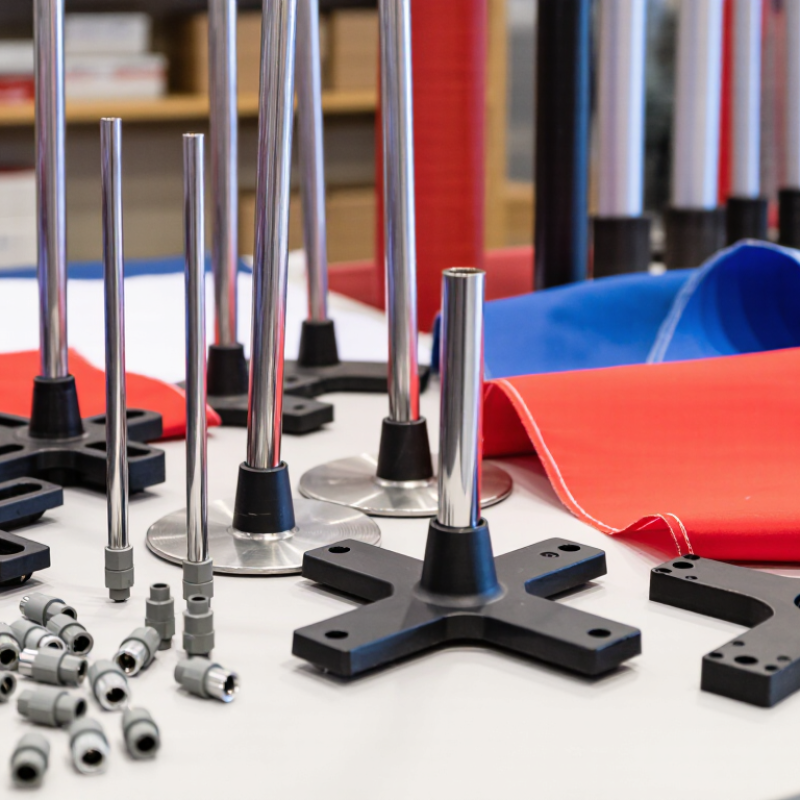
Flag hardware performs best when its parts are matched to the flag, site, and expected wind. A pole should be tall enough for clear visibility, yet manageable during installation. Check its material, diameter, joint strength, and finish. A flexible pole may suit a beach flag, while a sturdier pole can support larger fabric outdoors. The fit matters.

Bases keep the display upright. Flat cross bases work on level indoor floors, while ground spikes suit soft soil. Water- or sand-fillable bases add weight, but need regular checks for leaks and shifting. Rotators let the flag turn with changing wind, reducing fabric twist. Mounting systems should hold firmly without crushing the pole; inspect clamps, screws, and contact points before use. I have seen a small mismatch cause wobbling, even when each part seemed well made. That detail is easy to overlook.

Tips: Match pole diameter to the base or mount. Test the assembled setup before placing it in a busy area. Check for loose fittings, sharp edges, and a base that rocks on the ground. Wind conditions change, and hardware needs attention too.

Product Specifications: Alloy Grades, Pole Dimensions, and Wind-Load Ratings

When comparing China-based flag hardware manufacturers, check the alloy certificate, not just “aluminum pole” on a quotation. The Aluminum Association’s Aluminum Design Manual gives design values by alloy, temper, and product form; 6061-T6 extrusions are commonly specified with minimum yield strength near 241 MPa, subject to thickness and certification. 6063-T6 is also used for formed poles, but its strength differs. Ask for the exact grade, temper, wall thickness, and mill test certificate. Small print matters.

Pole dimensions should state overall height, outside diameter, wall thickness, and any tapered sections. A 6-metre pole with a 76-mm base diameter will behave differently from a uniform tube of the same height. Request drawings showing joints, base plates, and anchor-bolt spacing. Wind ratings need equal care. ASCE/SEI 7-22 uses site conditions and exposure factors; its basic velocity-pressure equation gives 25.6 psf at 100 mph before design coefficients and adjustments. That is not a complete pole rating. Ask whether the stated speed is a three-second gust, and request the calculation assumptions, including exposure and installed flag area. A number without those details can mislead. Real sites vary.

China Top 10 Advertising Flag Hardware Manufacturers? – Product Specifications: Alloy Grades, Pole Dimensions, and Wind-Load Ratings
Reference Configuration Typical Alloy Grade Pole Length Pole Diameter / Wall Thickness Indicative Wind Design Pressure Equivalent Reference Wind Speed
Compact feather-flag pole set 6063-T5 aluminum 2.4 m Ø16–25 mm; 1.0 mm wall 0.14 kPa 15 m/s
Small teardrop-flag pole set 6063-T5 aluminum 2.8 m Ø16–28 mm; 1.0 mm wall 0.20 kPa 18 m/s
Standard feather-flag pole set 6063-T6 aluminum 3.4 m Ø18–30 mm; 1.0–1.2 mm wall 0.25 kPa 20 m/s
Standard teardrop-flag pole set 6063-T6 aluminum 3.8 m Ø18–32 mm; 1.0–1.2 mm wall 0.30 kPa 22 m/s
Large feather-flag pole set 6061-T6 aluminum 4.5 m Ø20–35 mm; 1.2 mm wall 0.38 kPa 25 m/s
Large teardrop-flag pole set 6061-T6 aluminum 5.0 m Ø22–38 mm; 1.2–1.5 mm wall 0.45 kPa 27 m/s
Heavy-duty outdoor flag pole set 6061-T6 aluminum 5.5 m Ø25–40 mm; 1.5 mm wall 0.55 kPa 30 m/s
Large-format Advertising Flag Pole set 6005A-T6 aluminum 6.0 m Ø25–45 mm; 1.5 mm wall 0.63 kPa 32 m/s
Reinforced segmented flag pole set 6005A-T6 aluminum 6.5 m Ø28–48 mm; 1.5–2.0 mm wall 0.75 kPa 35 m/s
Extra-large reinforced flag pole set 6061-T6 aluminum 7.0 m Ø30–50 mm; 2.0 mm wall 0.98 kPa 40 m/s
Note: These are representative hardware configurations, not ranked manufacturers or certified product ratings. Wind pressures are approximate reference dynamic pressures calculated from the listed wind speeds; actual allowable wind performance depends on flag area and shape, pole joints, base, anchoring, exposure, and applicable design standards. Confirm project-specific ratings with engineering data.

China’s Top 10 Manufacturers: Locations, Product Lines, and Export Markets

China’s advertising flag hardware sector is spread across several manufacturing belts, rather than one single hub. Zhejiang, including Ningbo and Wenzhou, has suppliers making poles, bases, connectors, and replacement parts. Guangdong firms often combine metalwork with textile-display components. Jiangsu and Shandong also serve buyers seeking metal fabrication and larger production runs. These are useful starting points, not a complete map.

A practical top-ten comparison should record each manufacturer’s location, core product lines, and export experience. Typical lines include feather-flag poles, cross bases, water-fillable bases, ground spikes, and banner fittings. Some factories focus on lightweight aluminum tubes; others offer steel parts or mixed kits. Ask for material specifications, packed dimensions, and sample photos. Small details matter. A base that looks sturdy in a showroom may wobble on uneven pavement.

Export markets commonly include North America, Europe, Southeast Asia, and the Middle East, but destination experience varies by supplier. Request recent shipment references and confirm packaging, labeling, and product requirements for your market. Do not treat a broad export claim as proof of consistent quality. Not always. Factory visits or independent inspections can help, though neither removes every risk. I would rank suppliers by verified fit, not by a polished catalog; that judgment can still miss things.

Factory Data Compared: MOQ, Monthly Capacity, Lead Time, and OEM Services

A useful comparison of China’s advertising flag hardware factories starts with comparable specifications: pole material, base type, finish, packaging, and order quantity. MOQ figures mean little without these details. A supplier may quote 500 sets for standard parts but require more for custom colors or tooling. Ask whether monthly capacity means finished, inspected units or a theoretical production maximum. The difference matters when a campaign needs several sizes at once.

Lead time should be separated into sample approval, production, inspection, and dispatch. The Institute for Supply Management’s December 2024 Manufacturing PMI recorded a Supplier Deliveries Index of 50.1, indicating slightly slower deliveries. That is a broad U.S. manufacturing signal, not a flag-hardware factory benchmark. Still, it shows why a quoted production window cannot guarantee arrival. The World Bank’s 2023 Logistics Performance Index assesses timeliness alongside tracking, infrastructure, and shipment quality. Request dated capacity records, recent delivery performance, and the shipping term behind each quotation.

OEM services need equally concrete checks. Confirm artwork file requirements, available finishes, logo placement, carton design, and sample charges in writing. Ask for a sample with the actual pole, connector, and base; a printed image alone cannot verify fit. Small details matter. Factory comparisons remain imperfect when suppliers define “capacity” differently, and I would not rank them from one quotation. A shared inquiry sheet makes MOQ, monthly output, lead time, and customization scope easier to compare.

Quality Benchmarks: ISO 9001:2015, Test Reports, and Warranty Terms

For a top-ten advertising flag hardware shortlist, treat quality documents as evidence to inspect, not badges to admire. The ISO Survey 2022 recorded 1,265,216 valid ISO 9001 certificates worldwide. That scale makes scope checks essential: confirm the certificate covers the factory and relevant production processes, and verify its status with the issuing certification body. ISO 9001 describes a quality management system; it does not certify a flag base, pole, or finished product. A polished certificate alone proves little.

Ask for recent test reports tied to the exact hardware model, material, and dimensions being quoted. Useful details include wind-load setup, cycle count, pass criteria, corrosion exposure, and photographs of any failure points. Check whether the report comes from an independent laboratory, and whether the tested sample matches the shipment specification. Small differences matter. A heavier base or thicker tube can change results. In practice, buyers sometimes overlook this.

Read warranty terms as carefully as test results. Compare coverage length, excluded wear or weather damage, replacement-part availability, and the steps required to make a claim. Request written confirmation of who pays freight and whether proof of purchase or installation records are required. The terms may still leave gray areas; flag them before ordering, not after a bent pole arrives. A sample inspection can catch finish defects, loose fittings, or sharp edges that paperwork may miss.