


ProMach is your partner from start to finish. Our product brands are grouped into distinct business lines that make the most sense to our customers, covering every function of the production line: Filling, Bottling & Capping, Decorative Labeling, Flexibles & Trays, Pharma, Handling & Sterilizing, Labeling & Coding, Robotics & End of Line, and Systems & Integration.
learn more


How to Choose the Best Packaging Systems for Your Business?
Choosing the right Packaging Systems can shape how smoothly products move from production to delivery. A small bakery filling 500 boxes each morning has different needs from a warehouse shipping thousands of mixed orders. Both need packaging that protects goods, supports efficient work, and fits their budget. The best choice is rarely the fastest machine or the most impressive specification sheet. It is the setup that solves real problems without adding unnecessary complexity.
Start by examining your products, daily volumes, packaging materials, and available floor space. A fragile glass jar may need careful cushioning, while a uniform carton may benefit from automated sealing. Consider labor requirements, changeover time, maintenance access, and compatibility with existing equipment. Ask suppliers for demonstrations using your actual products and materials. Watch for practical details, such as whether operators can reach controls comfortably or clear a jam safely. Small observations matter.
Costs deserve a closer look. Purchase price is only one part of ownership; energy use, spare parts, training, and downtime also affect long-term value. Yet estimates can miss real-world variation. No system is perfect. A solution that works during a quiet month may struggle during seasonal peaks, and a highly automated line may not suit frequent product changes. Compare options using clear operating goals, not vague promises. Input from production staff, maintenance teams, and packaging specialists can reveal trade-offs that a sales brochure overlooks. This guide explores how to assess those factors, ask better questions, and choose a system that can grow with your business.
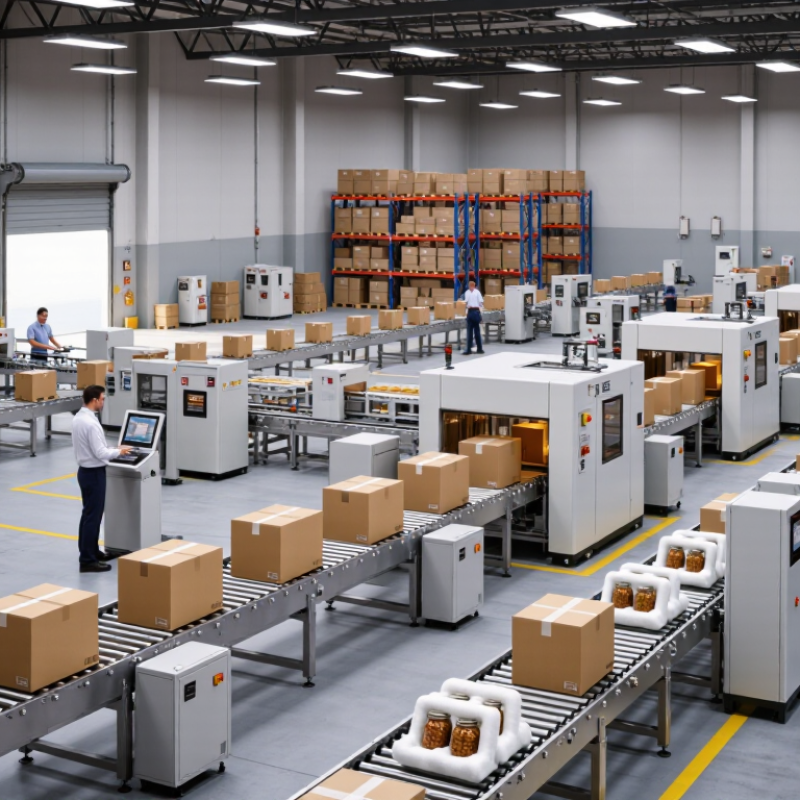
Define Your Packaging Requirements and Business Objectives
Before comparing packaging systems, write down what each product must survive. A glass jar shipped across a rough route needs different protection from a soft pouch sold locally. Note product dimensions, weight, fragility, moisture sensitivity, and expected storage time. Small details matter. Measure real orders, not just the ideal sample.
Define business objectives with measurable targets for daily output, labor hours, damage rate, and cost per packed unit. Include material use too. An affordable machine may still slow a team if changeovers take twenty minutes. Savings can disappear. Compare current packing time with a short trial using the same products and staff. Keep the test ordinary.
Consider how often formats change and how much floor space is available. A system that handles one carton quickly may struggle with six sizes and frequent label updates. Ask operators to test loading, clearing jams, and cleaning; their feedback often reveals awkward steps that a specification sheet misses. No plan is perfect. Leave room for seasonal peaks, but avoid buying capacity that sits idle most of the year.
How to Choose the Best Packaging Systems for Your Business? — Define Your Packaging Requirements and Business Objectives
| Requirement to Define | Business Objective | Information to Collect | Packaging System Implications | Practical Planning Guidance |
|---|---|---|---|---|
| Product characteristics | Protect product quality and reduce damage or waste | Product dimensions, weight, fragility, shape, temperature sensitivity, and whether it is solid, liquid, powder, or particulate | Fragile items may need cushioning or controlled case packing; liquids may require filling, capping, and leak-checking equipment; irregular products may need flexible feeding or manual loading. | Test the product with the proposed package and handling process. Confirm protection through suitable transit or drop testing for the intended distribution conditions. |
| Required output and demand variability | Meet production demand without paying for unused capacity | Average and peak units per hour, shifts per day, seasonal peaks, order mix, and expected growth | Manual systems can suit low or variable volumes; semi-automatic equipment can reduce repetitive work; automated lines are more appropriate when demand is steady and sustained. | Calculate the required rate from sellable units per shift, planned operating time, changeovers, breaks, and expected downtime—not from theoretical machine speed alone. |
| Package format and size range | Provide a consistent presentation and fit multiple product formats | Primary and secondary package types, case dimensions, pack counts, closure style, and number of stock-keeping units | Carton erectors and case sealers support regular corrugated cases; flow wrappers suit many individual solid products; filling and capping systems suit containers. Format changes may require tooling or adjustment. | List current and planned formats before requesting quotations. Ask suppliers to demonstrate changeovers using the actual package sizes and materials. |
| Changeover frequency | Limit lost production time when switching products or package sizes | Changeovers per shift, number of formats, typical changeover duration, and cleaning or sanitation needs | Frequent changes favor accessible adjustments, quick-release parts, clear settings, and equipment designed for the required range. Dedicated equipment may be more efficient for long, stable runs. | Include changeover and cleaning time in capacity calculations. Compare the full changeover process, including material replenishment and first-piece approval. |
| Packaging materials | Balance product protection, material availability, and packaging cost | Material type and thickness, recycled content, barrier needs, sealing characteristics, supplier lead times, and storage conditions | Equipment must reliably feed, form, fill, seal, label, or close the selected materials. Changes in material stiffness or seal behavior can affect performance. | Run trials with production-intent materials. Confirm material specifications and availability before choosing equipment or making sustainability claims. |
| Labor and operator skills | Improve productivity while keeping operation manageable | Staffing per shift, available technical support, training time, ergonomic tasks, and operator turnover | Automation can reduce repetitive handling but introduces setup, troubleshooting, and maintenance tasks. Manual or semi-automatic equipment may be easier to adapt in low-volume operations. | Assess the complete workload, including feeding, inspection, replenishment, cleaning, and maintenance—not only the number of operators at the machine. |
| Quality, traceability, and compliance | Meet customer, product-safety, and applicable regulatory requirements | Required label information, lot or date coding, inspection checks, records, and any product-specific rules | Systems may need print-and-apply labeling, coding, checkweighing, vision inspection, reject handling, or documented process controls. | Identify applicable requirements for the product and sales markets with qualified compliance personnel. Validate inspection and rejection processes before launch. |
| Available floor space and utilities | Fit the system into the facility without disrupting material flow | Usable footprint, ceiling height, access routes, electrical supply, compressed air, ventilation, and service clearances | Equipment layout affects infeed, discharge, operator access, maintenance access, and connections to upstream or downstream processes. | Request a dimensioned layout that includes guarding, walkways, material staging, and maintenance access. Verify site utilities before installation. |
| Total cost of ownership | Achieve a sustainable return on investment | Equipment and installation cost, labor, materials, energy, maintenance, spare parts, training, downtime, and expected service life | A lower purchase price may involve higher labor or operating costs; a more automated system may require greater investment and technical support. | Compare options over the same planning period and production assumptions. Include installation, commissioning, routine maintenance, and expected downtime. |
| Future flexibility | Support business growth and product changes | Forecast product launches, volume changes, new package formats, and possible line expansion | Modular equipment, adjustable ranges, and compatible interfaces can make future additions easier, but flexibility should match realistic business plans. | Prioritize documented requirements and credible forecasts. Confirm which upgrades are possible, their costs, and whether they require new tooling or line modifications. |
Planning note: The best system depends on the product, package, production mix, facility, and operating targets. Validate key assumptions with package trials, line-layout reviews, and a total-cost comparison before purchase.
Related Posts
-
2026 Top Packaging Systems for Global Buyers
-

Form Fill Seal Machines in Different Manufacturing Sectors A Comparative Analysis
-
10 Best Packing Equipment Suppliers for Global Buyers
-
Ultimate Guide to Choosing the Best Packaging Equipment: Insights and Data for Optimal Efficiency
-

Why Choose Form Fill Seal Packaging for Your Business Needs?
-
Discover Top-Quality Packaging Systems from China's Leading Manufacturing Experts